
Emergency Plumbing: The First Minutes
A burst pipe, a sewage backup or a house with no water starts a clock. Every minute the water runs, more of it soaks into floors, walls and ceilings, and the size of the repair afterward depends on how fast someone stops it. That starts with knowing which valve to close.
Gas Comes First, Water Second
If You Smell Gas, Leave the House Now
Get everyone out, pets included, and don’t stop to look for the leak. Don’t flip a light switch, unplug anything, light a match or use a phone inside: any of them can make a spark. From outside and well away from the house, call the gas utility’s emergency number (or your propane supplier) and 911. Do that first, before you call a plumber.
The plumbing can wait until the utility says the house is safe. With water and sewage it’s the other way around: stop the source yourself, then call us and tell us what happened. If something can’t wait for the visit, tell us, and we’ll explain what to shut off in the meantime.
Shutting Off the Main and the Water Heater
Find the main shutoff on a calm day and hang a tag on it. In most Lancaster homes it’s in the basement, on the wall where the water line comes in from the street, right beside the water meter; in an older row home that usually means the front wall. Crawl-space and slab houses often have it near the meter, in a utility room or the garage.
- Close the main. A round-handled gate valve turns clockwise, several full turns, until it stops; a lever-handled ball valve takes a quarter turn and is closed when the lever sits across the pipe.
- Don’t force a stuck valve: a wrench on a seized gate valve can snap the stem. If it won’t move by hand, ask the water provider about closing the valve at the curb.
- Open a faucet at the lowest point in the house, such as a laundry tub, to drain the lines.
- Shut down the water heater. On a gas heater, turn the control knob to “Pilot” or “Off”; on an electric heater, switch off its breaker, since an element that heats an empty tank burns out.
- Close the cold-water valve on the pipe that feeds the heater, usually just above the tank. When the heater itself is the leak, steps 4 and 5 are often enough, and the rest of the house keeps its water.
- Keep clear of water near outlets, cords or the electrical panel, and switch off a circuit only if you can reach the panel from dry ground.
First Moves for Six Plumbing Emergencies
Each of these has one thing to do right away and one mistake that makes it worse.
| Emergency | Do immediately | Do not do |
|---|---|---|
| Burst or leaking pipe | Close the main shutoff, open a low faucet to drain the lines, and move belongings out of the water’s path. | Don’t walk through standing water near outlets or cords, or turn the water back on to find the leak. |
| Sewage backup | Stop using water everywhere in the house: every flush and every load of laundry ends up at the lowest drain. | Don’t pour chemical drain cleaner into the line or clean up barehanded: sewage carries bacteria. |
| No water | Ask a neighbor or the water provider whether the street is out; if it’s only your house, check the main shutoff and, in a cold snap, look for a frozen pipe. | Don’t leave taps open and walk away: when the water comes back, they run until someone notices. |
| Water heater leaking | Turn the gas control to Pilot or Off, or switch off the breaker, then close the cold-water valve above the tank. | Don’t open the drain on a hot tank, and never cap a relief valve that is spitting water: it’s the tank’s last safeguard. |
| Frozen pipe | Open the faucet the pipe feeds and warm the pipe with a hair dryer, working back from the faucet. | Never use a torch or any open flame: it can set the framing inside the wall on fire. |
| Gas smell | Get everyone out, then call the gas utility and 911 from outside. | Don’t flip switches, use a phone inside, light anything or look for the leak. |
Thawing a Frozen Pipe Without a Flame
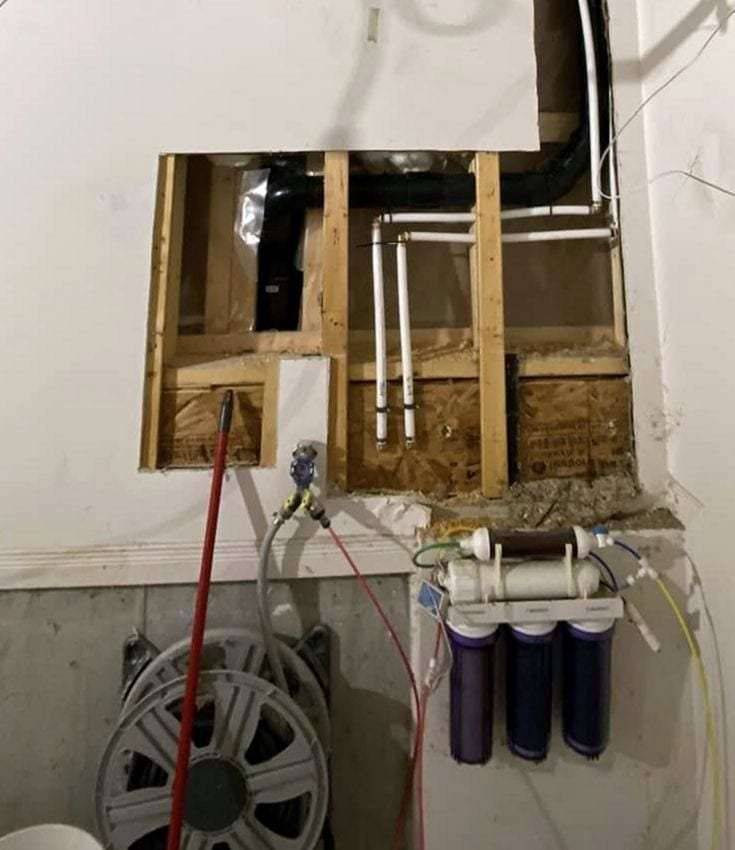
Lancaster’s cold snaps find the pipes in the wrong places: sink lines on outside walls and runs through crawl spaces and unheated garages. The first sign is usually a faucet that gives a trickle or nothing on a cold morning.
- Open the faucet the frozen pipe feeds, so melting ice has somewhere to go.
- Open the cabinet doors under the sink to let the room’s heat in.
- Warm the pipe with a hair dryer, starting near the faucet and working back toward the cold section.
- Keep the faucet open until full flow comes back.
Never put a torch or any other open flame to a frozen pipe: framing catches fast, and heating one spot can turn trapped ice to steam and split the pipe. Watch the line as it thaws, too. If you see a bulge or a crack, or hear water running inside a wall, close the main before it thaws all the way; a split line calls for leak repair, not more heat.
Send Photos Once You’ve Called
After you’ve called or booked, email photos to manager@musserparkplumbing.com: a wide shot that shows where the problem is in the house, a close-up of the pipe, fitting or stain, and the label on the water heater if it’s involved. Take them before you clean up, as long as you can do it without standing in sewage or near wet wiring.
What Counts as an Emergency
Which plumbing problems can’t wait?
Water you can’t stop at a fixture’s own valve, sewage coming up through a drain, no water to the house, a water heater leaking from the tank, a sump pump that quits while water rises in the pit, and a frozen pipe in a cold snap. A gas smell comes before all of them and goes to the gas utility and 911.
Is a dripping faucet or a running toilet an emergency?
No. Both waste water, but neither will damage the house in the meantime. Close the small valve under the sink or behind the toilet if the sound bothers you; both are ordinary fixture repairs.
Is it still an emergency once the water is off?
Once the water is stopped, what’s left is a repair. If you closed a fixture’s own valve rather than the main, the rest of the house keeps its water while it waits; tell us what you shut off when you call.
Does a leaking water heater have to be replaced?
Not always. A leak at a fitting, the drain valve or the relief valve can often be repaired, but a tank leaking through its own wall usually means a new water heater.
Stop the Water, Then Call Us
With the source shut off and everyone clear of the water, what’s left is a repair. Call us, or book an estimate with what happened and what you shut off.