
Water Heater Repair and Replacement
A water heater that quits has usually lost one part: an element, a thermostat, a thermocouple or a gas valve. Sometimes it’s the tank itself, and no part fixes a tank that leaks. We repair and replace tank and tankless water heaters in Lancaster and the nearby towns, and when a heater is close to the end, it’s worth settling the size and the fuel before it fails on a cold morning.
The Warnings a Water Heater Gives
Most heaters give some warning before they quit. These are the signs worth acting on:
- Rusty or brown hot water. If only the hot side runs discolored, the anode rod may be used up and the tank starting to rust from the inside.
- Popping or rumbling. Sediment on the bottom of the tank traps water that boils in bursts beneath it.
- Water pooling at the base. It may be a fitting on top, the drain valve or the relief valve’s pipe; if it’s the tank itself, the heater has to be replaced.
- No hot water. On an electric heater, a tripped breaker, a failed element or a thermostat; on gas, a pilot that won’t stay lit, a thermocouple or the gas control valve.
- Hot water that runs out early. A failed lower element, a broken dip tube or a tank half full of sediment.
- A rotten-egg smell from the hot tap. Bacteria in the water react with a magnesium anode rod, and a rod of a different metal usually ends it.
Leave the Relief Valve to a Plumber
The temperature and pressure relief valve, on the top or side of the tank with a pipe running down toward the floor, opens if the water gets too hot or the pressure climbs too high. If it drips, runs or won’t close after opening, call a plumber. Never cap or plug its discharge pipe, and don’t test an old valve that hasn’t moved in years: it may not seat again.
Repair the Part or Replace the Heater
Thermostats, heating elements, thermocouples, igniters, gas control valves, dip tubes and anode rods can all be replaced, and on a heater with years left in it, that’s usually the right call. A tank that leaks can’t be repaired: the steel has rusted through from the inside, and the leak only grows.
Age changes the decision. Tank heaters typically last 8 to 12 years, less where sediment has been left to build, and the manufacture date is usually coded into the serial number on the label. When a heater near the end of that range needs a major part, replacing it is often the better use of the money, and the moment to choose size and fuel on purpose instead of by habit.
Tank, Tankless or Heat Pump
The three types heat water differently, and the house decides as much as the household does: the fuel it has, the room around the heater and the venting it needs.
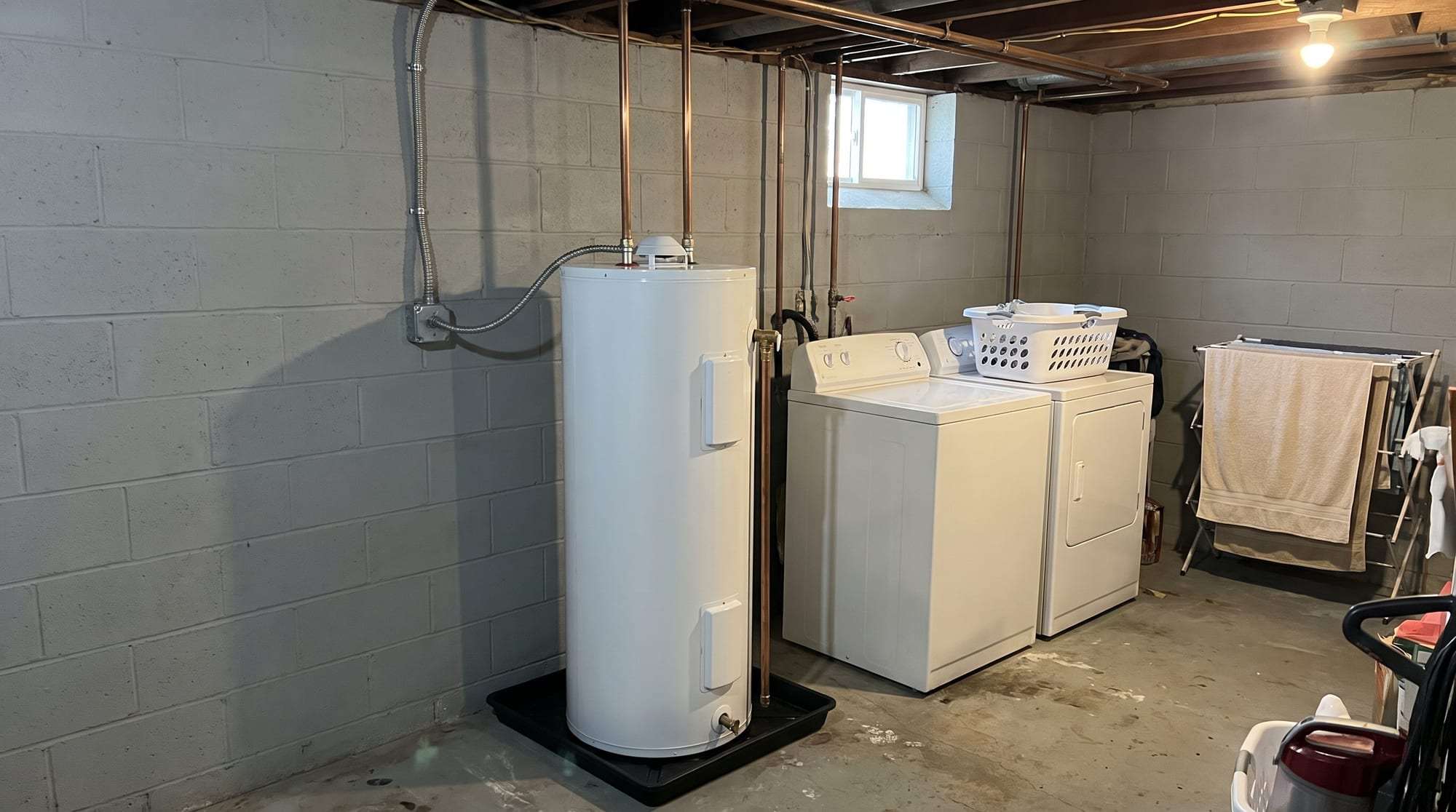
| Type | Fuel | Typical lifespan | Space needs | Best fit |
|---|---|---|---|---|
| Tank (storage) | Natural gas, propane or electric | 8 to 12 years is typical; hard water and skipped flushing shorten it | Floor space about 2 feet across; gas models need a flue and air for combustion | Most houses, and a straight swap for the heater already there |
| Tankless (on-demand) | Natural gas or propane; whole-house electric models need heavy electrical service | Often around 20 years, with regular descaling | Hangs on a wall; gas units need their own venting and often a larger gas line | Long or back-to-back showers, tight spaces, and a gas supply big enough to feed it |
| Heat pump (hybrid electric) | Electricity, with heat drawn from the surrounding air | Usually 10 to 15 years | A taller tank, open air around it and a drain for condensate; it cools the room it sits in | Houses heating water with electricity now, with a roomy basement that isn’t too cold |
Fuel is usually settled by what’s already there: gas recovers fastest where the house has a gas line, and outside the gas mains many homes run propane or electric. A heat pump water heater uses far less electricity than a standard electric tank, but it draws its heat from the air, so in a cold basement it slows down and leans on its backup elements through the winter.
Size a Heater for the Busiest Hour
A water heater is sized for the busiest hour of the day, not the daily total. For a tank, the figure that matters is the first-hour rating: how many gallons of hot water it can deliver in an hour, starting full. It’s on the yellow EnergyGuide label and the spec sheet, and it says more than the size of the tank.
A tankless heater is sized by flow: how many gallons a minute it can heat, and by how many degrees. In winter, water comes into Lancaster homes at roughly 40 to 45°F, so bringing it to 120°F takes a rise of 75 to 80 degrees. A unit that runs three showers in August may manage two in January, so compare the flow at the winter rise, not the best-case figure on the box.
Water Heater Size Guide
Choose the number of people and the fuel, then press Show the Size.
Hard Water Wears a Heater Down
Much of Lancaster County sits on limestone, and the water that comes up through it is hard. Its calcium and magnesium drop out when water is heated: in a tank they settle on the bottom as sediment, on an electric element they bake on as scale, and in a tankless heat exchanger they coat the narrow passages and choke the flow. The sediment is what makes a gas tank pop and rumble, and it wastes heat on every cycle.
Two Habits That Slow the Damage
Flushing a tank drains out loose sediment before it hardens into a layer, and once a year, as part of a seasonal plumbing routine, is the usual pace. Checking the anode rod every few years catches it before the tank starts to rust, and a tankless unit needs its heat exchanger descaled on its maker’s schedule, which comes around often in hard water.
Flushing the Tank and Changing the Anode
How often should a tank water heater be flushed?
Many manufacturers call for once a year, and hard water makes that schedule worth keeping. If a tank hasn’t been flushed in years, ask a plumber first: an old drain valve may not close tight once it’s opened, and a thick layer of sediment can plug it.
How do I flush the tank myself?
Turn the heat off first: the gas control to “pilot,” or the breaker for an electric heater. Close the cold inlet, run a hose from the drain valve to a floor drain, open a hot tap upstairs and open the drain valve; the water comes out scalding. Once it’s empty, open the cold inlet in short bursts until the water runs clear. Close the drain, refill with a hot tap open until water flows, and only then turn the heat back on: an element switched on in an empty tank burns out almost at once.
What does the anode rod do?
It’s a rod of magnesium or aluminum that hangs inside the tank and corrodes on purpose, so the steel tank doesn’t. Once it’s eaten down to its core wire, the tank starts to rust. Replacing it before it’s gone is one of the few things that lengthens a tank’s life, but it takes a large socket, a strong pull and room overhead, so it often gets left alone.
Does a water softener change any of this?
It cuts down the scale, which helps a tank and helps a tankless unit even more. Softened water wears through an anode rod faster, though, so in a house with a softener the rod needs checking more often.
No Hot Water, or a Heater on Its Last Years
Call or book an estimate and tell us the heater’s fuel, its age if you know it and what it’s doing: no heat, a leak, a noise or hot water that runs out early.